Blog
The Building That Disappears
As AI and smart systems become embedded in architecture, buildings are beginning to anticipate our needs, creating more intuitive, responsive, and human-centred experiences.
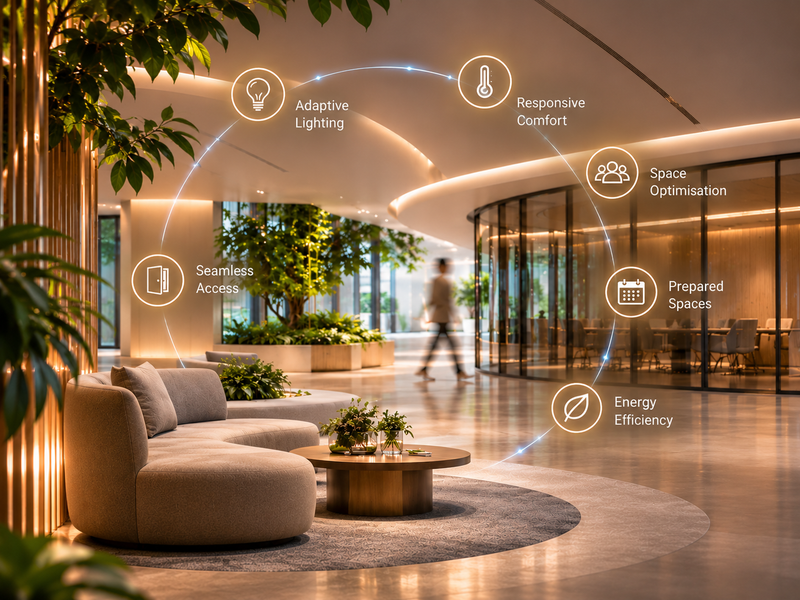
The most intelligent building may be the one you barely notice.
For years, technology in architecture was something to be seen. Screens, control panels, interfaces, and visible systems became shorthand for progress. But the next generation of intelligent environments is moving in the opposite direction. The technology is becoming quieter, more integrated, and increasingly invisible.
The result is not a building that does more for the sake of it. It is a building that asks less of the people using it.
Lighting adjusts without interruption. Temperature responds to changing occupancy. Meeting rooms are prepared before users arrive. Hotel rooms remember preferences. Building systems track performance and identify inefficiencies before they become problems. Access becomes seamless. Energy use responds in real time to how spaces are actually being used.
None of this needs to feel overtly technological. That is the shift.
From reactive to anticipatory
Traditional buildings are largely reactive. A user enters a space, notices something is wrong, and then makes an adjustment. They switch on a light, lower the blinds, change the temperature, search for a meeting room or call someone when something stops working.
Intelligent environments increasingly remove those moments of friction.
Sensors, connected systems, automation, and artificial intelligence allow buildings to interpret information continuously and respond to changing conditions. Occupancy data can help control lighting and cooling. Building management systems can optimise energy consumption. Predictive maintenance can identify potential equipment failures before they disrupt operations. Hospitality environments can increasingly personalise experiences around the preferences and behaviours of individual guests.
The user does not necessarily need to know any of this is happening. They simply experience an environment that feels more comfortable, intuitive and responsive. Technology becomes less about interaction and more about anticipation.
Designing for systems, not devices
For designers, this changes the brief. It is no longer enough to think about technology as something added to a building after the architecture and interiors have been resolved. Increasingly, the intelligence of a space is embedded within the design from the beginning.
Architecture, interiors, lighting, environmental systems, digital infrastructure, and operations need to work together as one connected ecosystem.
That requires designers to understand not only what a system can do, but how it affects behaviour, comfort, and experience. A sensor may determine whether a light remains on, but its positioning affects how reliably the space responds.
A smart hotel room may allow multiple systems to work through a single interface, but the quality of the experience depends on whether that interface feels intuitive rather than complicated. An adaptive workplace may adjust according to occupancy, but designers still need to understand which spaces people want to use, how they move between them and what makes them feel comfortable enough to stay.
The technology may be invisible. Its impact on design is not.
The paradox of intelligent buildings
There is a paradox at the centre of smart building design. The systems behind an intelligent environment are becoming increasingly sophisticated, while the experience they create should become increasingly simple.
Users should not need to understand the layers of technology operating around them. When a system constantly demands attention, asks for input or introduces another interface, it risks creating more friction rather than removing it.
Good intelligent design therefore depends as much on restraint as capability. Just because something can be automated does not mean it should be.
The goal is not to create environments that continuously demonstrate how intelligent they are. It is to identify where technology can remove unnecessary effort and allow people to focus on what they came to the space to do.
In a workplace, that may mean making collaboration easier. In a hotel, it may mean removing small interruptions from the guest journey. In healthcare, it may mean creating environments that respond more sensitively to patients and staff. In residential design, it may mean creating homes that adapt without becoming complicated to operate.
The measure of success is not the number of systems installed. It is whether the environment feels easier to use because they are there.
Designing the invisible
As technology becomes more embedded in the built environment, designers are increasingly responsible for something they may never physically draw. The relationship between people, systems, and space.
That relationship needs to feel natural.
It requires architects and interior designers to work more closely with technology stakeholders earlier in the design process. It also requires a deeper understanding of how buildings perform after they are occupied.
The traditional boundary between physical and digital design is becoming harder to define, and perhaps that is the point. The future of intelligent design may not be a world filled with more visible technology. It may be one where the technology disappears almost entirely into the architecture.
Where the building anticipates rather than interrupts. Where complexity sits behind the scenes. And, where the user experiences only the result. An environment that simply works.